Why Are We Defeated Before We Even Fight?
Defeat as a Broken Path
We live in a society that equates defeat with failure. Success is imposed as the foremost value, and everything seems to revolve around achieving it. To triumph is to climb higher, to go farther, to stand out above others. Within this logic, defeat is not just a transitional moment or a chance to learn, but a mark of inadequacy. Competitiveness has become the everyday language: in the marketplace, where every product aims to prevail; in the global and personal economy, structured around constant performance and growth; in workplace structures, where each worker is expected to excel to remain relevant; in the sports we play or fervently follow, where identity forms around winning or losing. Even in daily life: in the neighbor who achieves more, in the number of reactions, emojis, or likes we receive, which end up functioning as a public measure of recognition.
Within this logic, defeat is not tolerated: it’s hidden, disguised, denied. Because to accept defeat would be to accept that we are not what we should be. That we failed. That we weren’t enough. Defeat becomes an intimate embarrassment, an event that disrupts not only a goal, but our own sense of validity.
We have come to normalize this association between defeat and failure, between losing and being worthless. And thus, we assume every defeat necessarily means someone else has won. But if we pause to observe more closely what we feel when we know we have been defeated, we discover that this experience doesn’t always require another to have bested us. Sometimes it’s enough that something didn’t happen as we expected, or what did happen failed to support what we envisioned. Defeat, in many cases, isn’t imposed from outside: it installs itself as an intimate loss, as the interruption of a projection we thought was stable, of a path we imagined was secure.
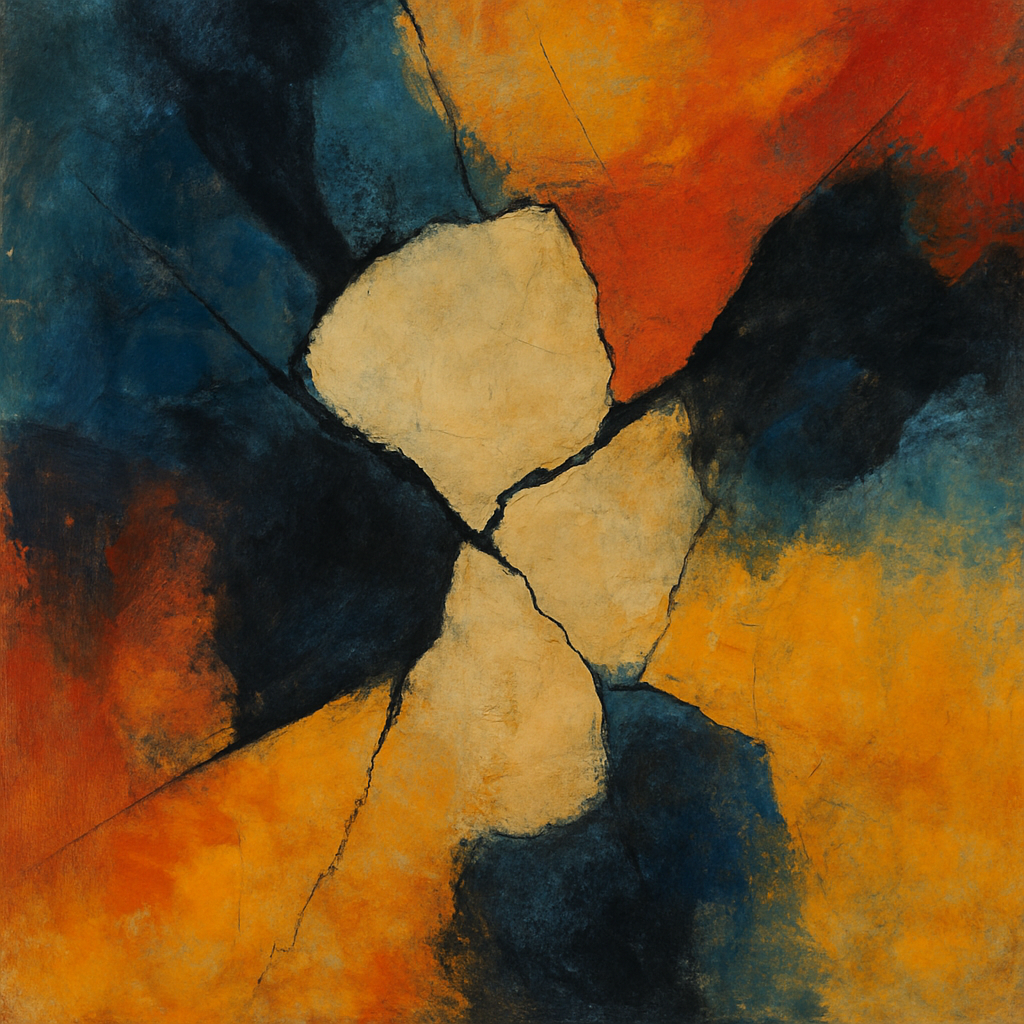
The word defeat comes from the Latin dirupta, meaning to break, to split, to shatter. Originally, defeat was not a public humiliation, but a fracture. A rupture: something violently interrupted. Later, the term became consolidated in navigation, where it refers to the course a ship follows or is scheduled to follow at sea. In that context, to be defeated doesn’t mean to have lost against someone, but to have lost one’s way: to stray from the route, to be unable to continue on the planned course, to fall off track. Defeat appears as the experience of deviation: a broken path.
Feeling defeated isn’t always not having arrived, nor being bested by another. Sometimes, it’s simply not knowing how to go on. It’s a loss of direction, not because of a failed goal, but for no longer being able to pursue the path as planned. Even amidst success—when what is wanted has been achieved—there might be that moment of bewilderment when the meaning that guided us no longer sustains us in the same way. Not because it’s exhausted, but because it no longer offers a clear direction. Defeat may arise there: in the interval between what can no longer continue and what has yet to change.
There are defeats born of failure: when we don’t reach what we sought, when something we hoped for doesn’t happen, or happens in an irreversibly different way. But there are also defeats that arise from success. Because fulfilling a desire, reaching a goal, can also reveal a void. The meaning that once moved us has been fulfilled, and with this, transforms: it can no longer operate as before. What once guided us is still there, but can no longer sustain us as before. It has not been replaced, but its function has changed. That interval, that moment without clear direction, can paradoxically also be experienced as a form of defeat.
From a neurobiological standpoint, humans are configured to anticipate. Our brain doesn’t only respond to what happens, but is constantly working on what it expects to happen. This anticipation allows us to orient ourselves, plan, and act with purpose. On a chemical level, this system is largely sustained by dopamine—not as the pleasure molecule, as it’s often called, but as a regulator of expectation. The brain releases dopamine when it anticipates a reward, when it perceives an action as leading to a desired outcome. Meaning, in this schema, is constructed on chains of prediction: the world takes shape according to what we believe will happen.
But these anticipations aren’t absolute: they are continually exposed to reality checks. When this happens, we face a threshold of change. The brain then enters one of two possible states: failure of prediction or fulfillment of prediction. In the first case, what was expected doesn’t happen: the result doesn’t arrive, the reward doesn’t appear, the world doesn’t respond as predicted. This creates a “prediction error” that activates the amygdala, intensifies stress, and forces the prefrontal cortex to reevaluate cognitive and emotional pathways.
In the second case—the fulfillment of prediction—something more subtle but just as complex occurs: dopamine drops sharply after achievement. The anticipation has been fulfilled, but the system is no longer activated. The meaning has been consummated, and with that, the tension sustaining it is deactivated. If a new direction doesn’t appear, what follows is confusion. Both failure and fulfillment of a prediction can produce a loss of meaning.
In both cases, the organism must carry out a deep reorganizing effort. It’s not just a mental reaction, but a physical, chemical, and symbolic endeavor. The limbic system modulates the emotional response, the prefrontal cortex must generate new projections, and the entire body adapts. If this process fails, confusion persists: the horizon disappears, the direction becomes diffuse. It’s not just that something has been lost: we don’t know how to name what comes next.
To be defeated, then, is to remain at that threshold where what once guided us has broken and the new has not yet emerged. It is to inhabit uncertain ground, where the direction has been interrupted, and where the actual risk is not the interruption itself, but the inability to forge a new path.
Grief as a Duel Between Two
This process of elaboration is what we call grief. And the term, like the experience it names, is double. It comes from Latin dolus—pain—but also from duellum—a duel between two. Grief is both a wound and a confrontation. A process of loss, but also a tension between two forces: what is no longer present and what has yet to arrive. In every defeat—whether born from failure or from fulfillment—a process of grief is initiated. Not just for what is lost, but for the meaning that organized our actions and is now inaccessible.
From a neurobiological perspective, grief implies an internal system conflict. The limbic system and prefrontal cortex must coordinate to process the changing scenario: the emotion of loss and the need for cognitive reorganization. It’s a tense dialogue between the emotional record of what was and the pursuit of a new schema to move forward. It is, in symbolic terms, a conflict between past and future. When that conflict can be inhabited, the brain undergoes reconfiguration: it allows us to rename the world, integrate the loss, generate new projections.
But if that conflict isn’t processed, it becomes displaced. And in a society that has turned every experience into competition, that displacement takes on a predictable form: what should be an inner conflict—between what we are no longer and what we cannot yet become—turns into a confrontation with the outside. Grief, which could be lived as a process between two temporalities of the self, gets translated under the dominant logic as a confrontation between two subjects. If something is lost, then someone has gained. If I am defeated, it’s because another has taken that place. Unprocessed grief thus becomes open accusation or covert envy, projected hostility. Not because the loss demands it, but because we believe everything one lacks, another possesses. This is where defeat becomes the cause of conflict, not its consequence.
We have learned to understand life under the logic of a zero-sum game: where all another’s gain equals one’s loss. Thus, imagining that if I am defeated, someone must have defeated me becomes almost automatic. Every loss seems to confirm another’s victory. But defeat doesn’t have to be caused by someone else. There are paths that break because they change form, because meaning changed; paths that are exhausted or reformulated, desires that are met—or met in a manner different from expectations—, forecasts that turn out otherwise. There need not be enemies. But there is interruption.
Grief needs time, needs space. It doesn’t happen in continuity, but in the pause. It requires stopping in order to reorient, to process what is gone and allow something new to take shape. But it also needs direction: one must reorient. When that psychic space isn’t opened, when grief is interrupted or displaced, the previous meaning persists but can no longer provide direction, preventing a new way of orienting from emerging.
At this point, the brain—devoid of a predictive structure connecting past and future—tends to fill that void with immediate gratification. Another, more primitive, circuit activates, seeking micro-stimuli to keep the dopaminergic system functioning. Likes, notifications, purchases, instant achievements. We don’t avoid grief because it doesn’t hurt, but because we don’t allow the system to cross the threshold that would enable it. And that threshold lies beyond pain, beyond interruption.
We live suspended between what no longer sustains us and what we don’t yet know how to name. We react without projecting, move without direction. The urge to fill the void overrides the possibility of going through it. In this way, life becomes filled with activity without transformation: a chain of stimuli that keeps the surface busy, while at the core everything remains the same.
This is why we need to understand that life is not—nor should be—a zero-sum game. In our most intimate relationships, ties, and projects, it’s not about winning so another loses, nor about assuming what we didn’t achieve was taken by someone else. It’s about building something that does not need to come at another’s expense. Life, in its fullest sense, is a non-zero-sum game: we only win if no one loses completely. There is only a future if there is space for all routes to be reshaped without being erased. And that means embracing grief: accepting defeats not as failures that define us, but as inevitable interruptions in the continuity of meaning.
Grief is, in this sense, work with our past. A farewell to what no longer sustains us, to imagine what has yet to take form. There’s no future without that farewell, no new meaning without accepting that the previous one has broken. To be defeated before fighting is often not having done that grieving. Not with others, but with oneself: with the desire that can no longer be sustained—through failure or fulfillment—, with the course that leads nowhere now, with the structure that must be left behind so something new can begin.