Why Was Judas Historically Necessary?
Judas as a paradigm: the break from within
In certain historical moments, betrayal does not come from outside, but from within. This kind of rupture carries a special weight because it does not just challenge norms or alliances; it destabilizes the symbolic core of a system. The figures of Judas and Brutus condense this type of betrayal. The same, on a contemporary geopolitical level, can be said of Donald Trump’s tariff policy towards his traditional allies.
Judas was not an external opponent to Jesus: he was part of his innermost circle, one of the twelve apostles. He betrays not only a person, but a direct link to the sacred. Brutus, for his part, was not merely a Roman senator: he was close to Julius Caesar, even considered by many to be his protégé. His stab was not only physical, but also symbolic: a denial of the legitimacy of central Roman power from within the circle of trust.
Something similar occurs when Donald Trump decides to impose tariffs on products from countries like Germany, France, or Canada. The United States, since the end of World War II, had been the main driver of the international liberal economic order: free trade, multilateral alliances, market openness. Institutions like GATT (predecessor of the WTO) were created with American support and leadership to cement this logic. Trump does not challenge this model from an external or alternative stance, but from the presidency of the country that designed and sustained it for decades.
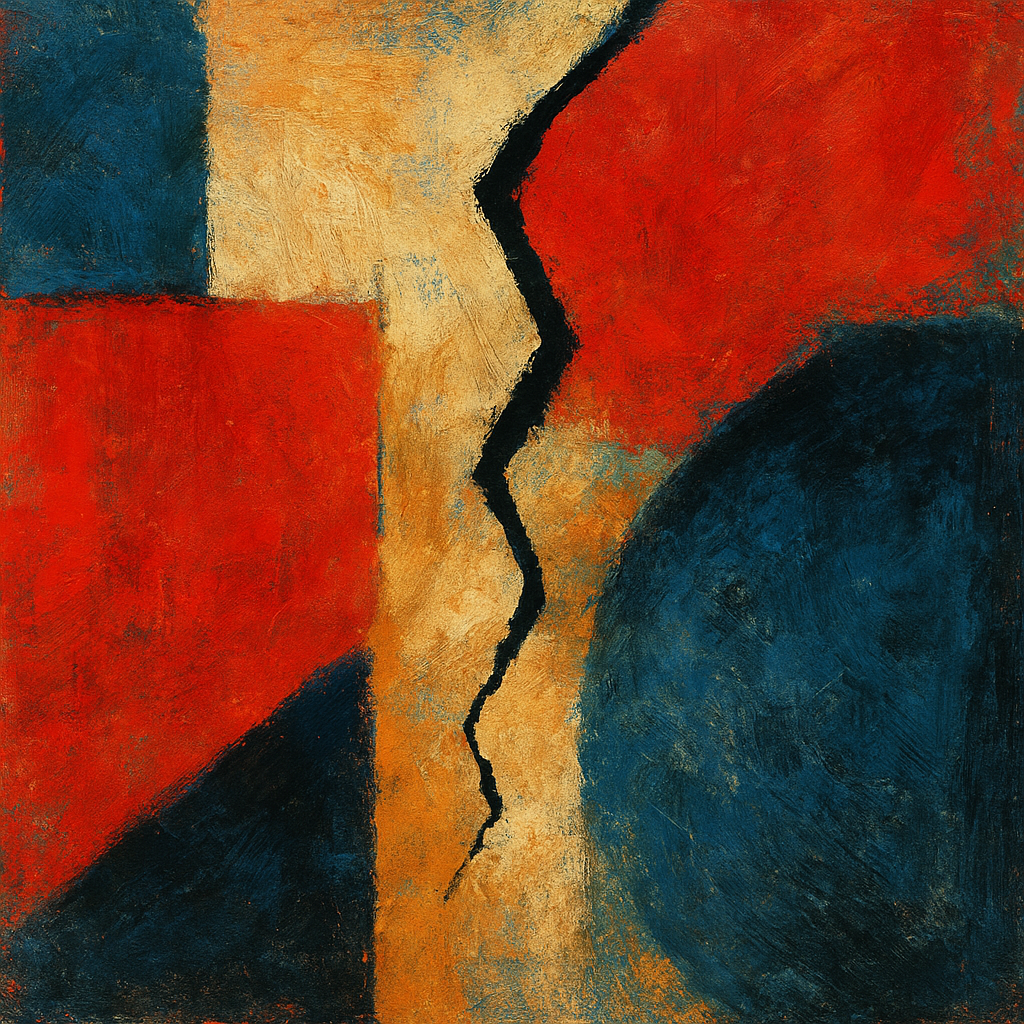
In this context, imposing trade barriers on allied countries is not just another protectionist measure. It implies breaking with the foundational agreement of the liberal Western order: the idea that free and fluid trade among capitalist democracies is the basis of global stability. This agreement had not only economic implications, but also ideological ones: it articulated a shared vision of the world. The fracture is not only political or strategic, but ontological: it affects the deep meaning of what that system is.
The ontological—that is, what has to do with how we conceive and understand the being and the order of things—is not easily broken. But when it breaks, there are no technical rules to repair it. The coherence of the model, its internal logic, is lost.
Breaking it means leaving behind the established consensus in the post-war period, especially from 1945, when the U.S. and Europe began to project themselves as a united economic and political bloc against the world. In simple terms: if for more than half a century free trade was the symbol of trust and cooperation among allies, tariffs transform it into a field of dispute.
Dante, in The Divine Comedy, places Judas and Brutus in the center of Hell, not for the magnitude of their crimes, but for the type of betrayal they represent: they do not destroy from outside, but from within. In that symbolic logic, Trump assumes a similar role. He does not confront the Western system from a critical periphery, but rather, from the core of power, breaks the rules that gave meaning to the whole.
This comparison does not seek to equate people, but to recognize a historical pattern: internal betrayal destabilizes by altering how the world is understood. It is no longer a conflict between different models, but a crack within the dominant model. What collapses is not just an alliance, but the moral, symbolic, and ontological structure on which it was sustained. This type of disruption is not corrected with new rules, because what is lost is trust as a structuring category. And without it, the entire ideological edifice falters.